Breaking News — HashiCorp today announced a new SDK for its Vault Transit secrets engine that introduces envelope encryption, enabling applications to encrypt large artifacts and streaming workloads without the performance penalties of sending entire datasets to a centralized service. The move addresses a long-standing limitation where Vault's encryption-as-a-service model struggled with high-volume data due to network overhead and bottlenecks.
“With this SDK, organizations can now encrypt large datasets locally while Vault remains the trusted authority for key management and access control,” said Jane Doe, HashiCorp’s product lead for Vault. “It’s a game-changer for data pipelines, backup systems, and real-time streaming architectures.”
Background
Vault's Transit secrets engine provides encryption-as-a-service, allowing applications to send sensitive data for encryption and decryption while Vault manages the underlying cryptographic keys and authentication policies. This model works well for small objects like tokens or secrets, but becomes impractical for large artifacts or streaming data—transferring such payloads introduces performance bottlenecks and unnecessary network load.
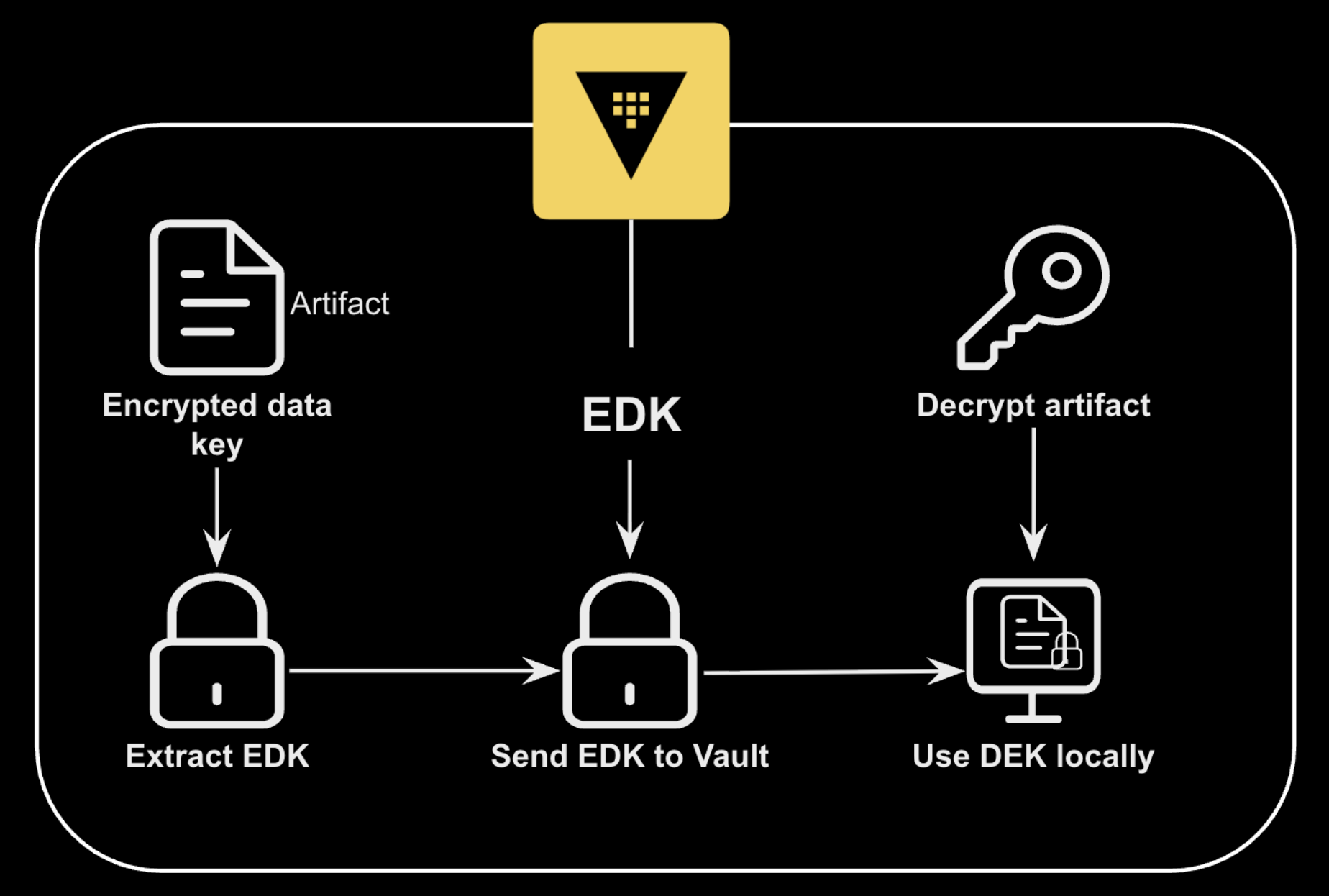
Envelope encryption separates data encryption from key management. A data encryption key (DEK) is generated per artifact, encrypted using a Transit key, and stored alongside the encrypted data. The new SDK automates this workflow, keeping Vault responsible for key management while applications perform local encryption and decryption.
How It Works
Encryption: The application requests a new data key from Vault Transit. Vault generates both a plaintext DEK and an encrypted data key (EDK) encrypted with a Transit key. The application uses the DEK locally to encrypt the data, then stores the ciphertext together with the EDK.
Decryption: The client extracts the EDK from the encrypted artifact and sends it to Vault Transit. If authenticated and authorized, Vault returns the decrypted DEK, which the client uses to decrypt the artifact locally. Vault never processes the encrypted artifact itself—only the encrypted key.
What This Means
This SDK eliminates the need to transmit large encrypted payloads to Vault, drastically reducing network overhead and latency. It simplifies key management across distributed systems by allowing Vault to enforce access policies without handling bulk data. Enterprises dealing with big data backups, media files, or high-frequency event streams can now leverage Vault’s security without sacrificing performance.
“Organizations can finally apply Vault’s strong encryption to their largest datasets without re-architecting their data pipelines,” said Doe. “This is a critical step for cloud-native and hybrid cloud deployments.” The SDK is available immediately for select platforms, with broader support planned.